Contents
How fast does an electric car/truck charge?
Every battery in an electric vehicle (EV) is controlled by a Battery Management System (BMS). This system is the brain of the vehicle and communicates with the charging station via a defined protocol. In the ideal world, this ensures that the vehicle charges at the maximum speed the charger can offer.
Yet we often get the question, "How long does it take to charge an electric car or truck?" The answer is not one simple number. In fact, there is almost always some bottleneck. Whether you are charging a passenger car or a heavy truck, the weakest link determines the final speed. In this blog, we explain what factors affect the charging time of an electric car and truck and why 100% power from 0 to 100% charge is technically impossible.
Limiting factors: What determines the charging time of an electric car?
When people search on "how fast does an electric car charge", they often end up with theoretical figures from manufacturers. In practice, these five factors play the main role:
- State of Charge (SoC): Battery percentage. Often, the last 20% cannot charge at full power.
- Temperature: Both battery cell and ambient temperature.
- Grid capacity: On-site grid connection limitation.
- Power of the charging station: The maximum current rating (Ampere) of the charging station.
The Physics: Why 0-100% charging at full power is impossible
Many people wonder: "How fast does an electric car charge from 0 to 100%?". Technically, it is impossible to do this constantly at maximum power because of cell technology. This has everything to do with the formula for power:
P (Power) = V (Voltage) * I (Amperage)
The three phases of charging
Manufacturers almost always name the charging time between 20% and 80%. This is the "sweet spot" of the battery.
- 0% to 20%: When the battery is very empty, the voltage is low. The BMS limits the current (I) to stabilise the chemistry and lithium plating (harmful deposition). The battery literally has to be "activated".
- 20% to 80%: The stage at which the charger can deliver its maximum amps.
- 80% to 100%: As the cells become full, the internal resistance increases. Power is slowly reduced to prevent overheating. This is why charging an electric car takes the longest in this final phase, relatively speaking.
The influence of Voltage (400V, 600V, 800V)
The voltage determines the efficiency. For a 500A charging station, it looks like this:
- 400V vehicle: 400V * 500A = 200 kW
- 600V vehicle: 600V * 500A = 300 kW (thus charges 1.5 times faster than 400V)
- 800V vehicle: 800V * 500A = 400 kW (charges twice as fast as 400V)
Temperature: Battery and Environment
How long does it take to charge an electric car in freezing temperatures or extreme heat? Temperature is a crucial variable:
- Battery temperature: A cold battery is chemically "slow". The BMS scales back the power to protect the cells.
- Environment and Hardware: Voltra chargers operate at full power up to 50 degrees, after this the power is scaled back. Our charging cables have sensors that monitor temperature; in case of heat, power is scaled down.
- HPC Solution: For high-power charging (from 500A), we use liquid-cooled cables so that the speed remains high even during long-term use.
Grid capacity and EMS
The load on the contracted power can quickly reach its limit. That is why we often add an EMS (Energy Management System). Where you can statically limit a charger, an EMS dynamically regulates energy flows based on solar panels, batteries and other consumption in the building. This keeps everything running while still charging as fast as possible.
Capacity of the charging station
The final factor is the hardware itself. At Voltra, we supply chargers with modules of 200A, 350A or 500A. If all other factors are optimal, this capacity determines how fast you can eventually get back on the road.
Case studies: How fast is "full"?
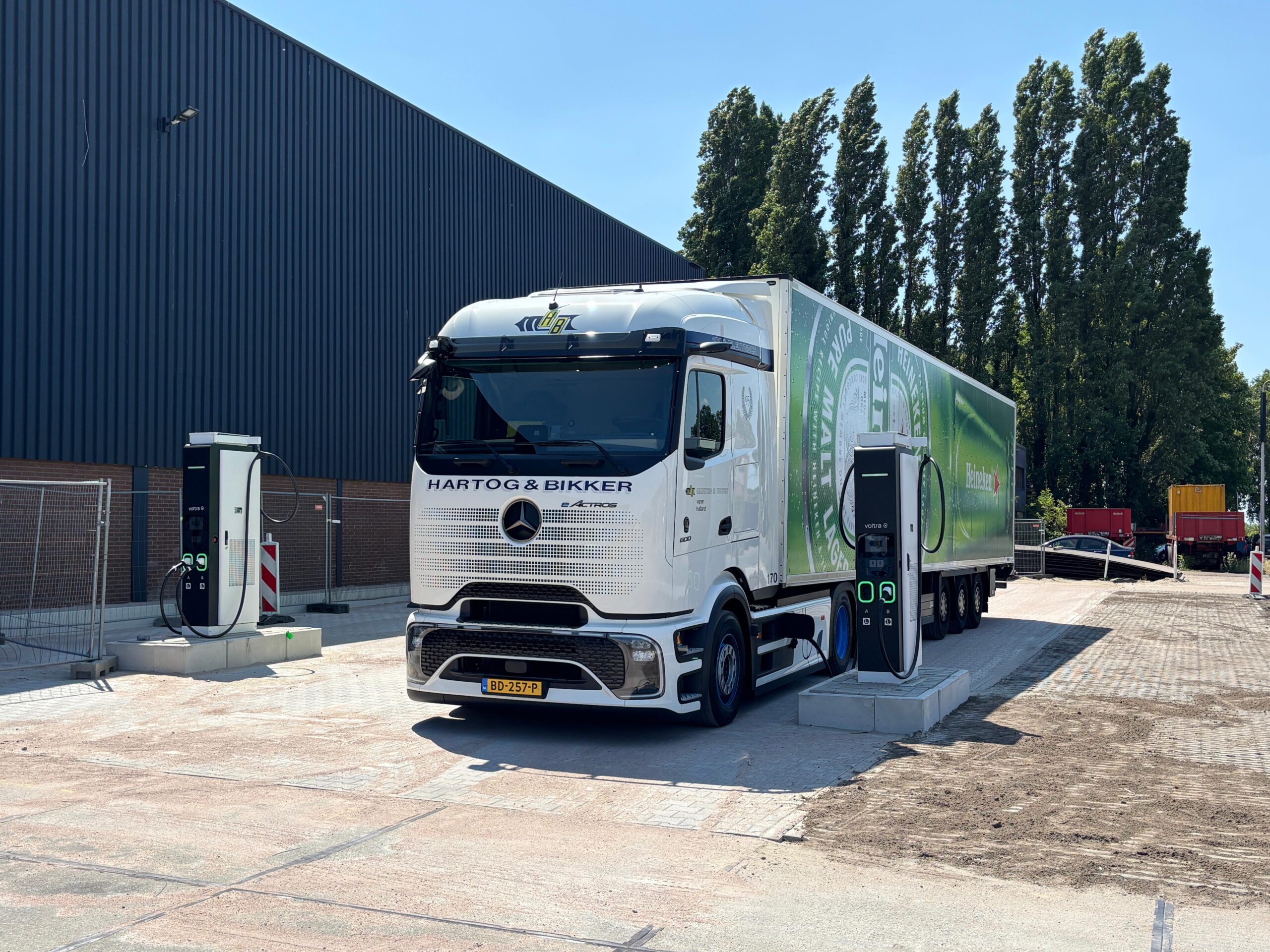
1. Electric truck: Mercedes e-Actros 600
A common model is the Mercedes e-Actros 600.
- Battery Architecture: The Mercedes e-Actros 600 uses an 800V system.
- Max. Payload: The truck is prepared for charging with 1MW (1000 kW). This is MCS (Mega Watt Charging) Currently, it is possible to charge 400kW via the standard CCS2 plug.
- Charging time: The truck is prepared for 1MW (1000 kW) charging. This allows the truck to be charged from 20% to 80% in just 30 minutes. Via a regular fast charger, it can charge at 400 kW. Thanks to its 800V architecture, it makes optimal use of the maximum current of most fast chargers. Charging from 20% to 80% takes an average of one hour in this scenario.
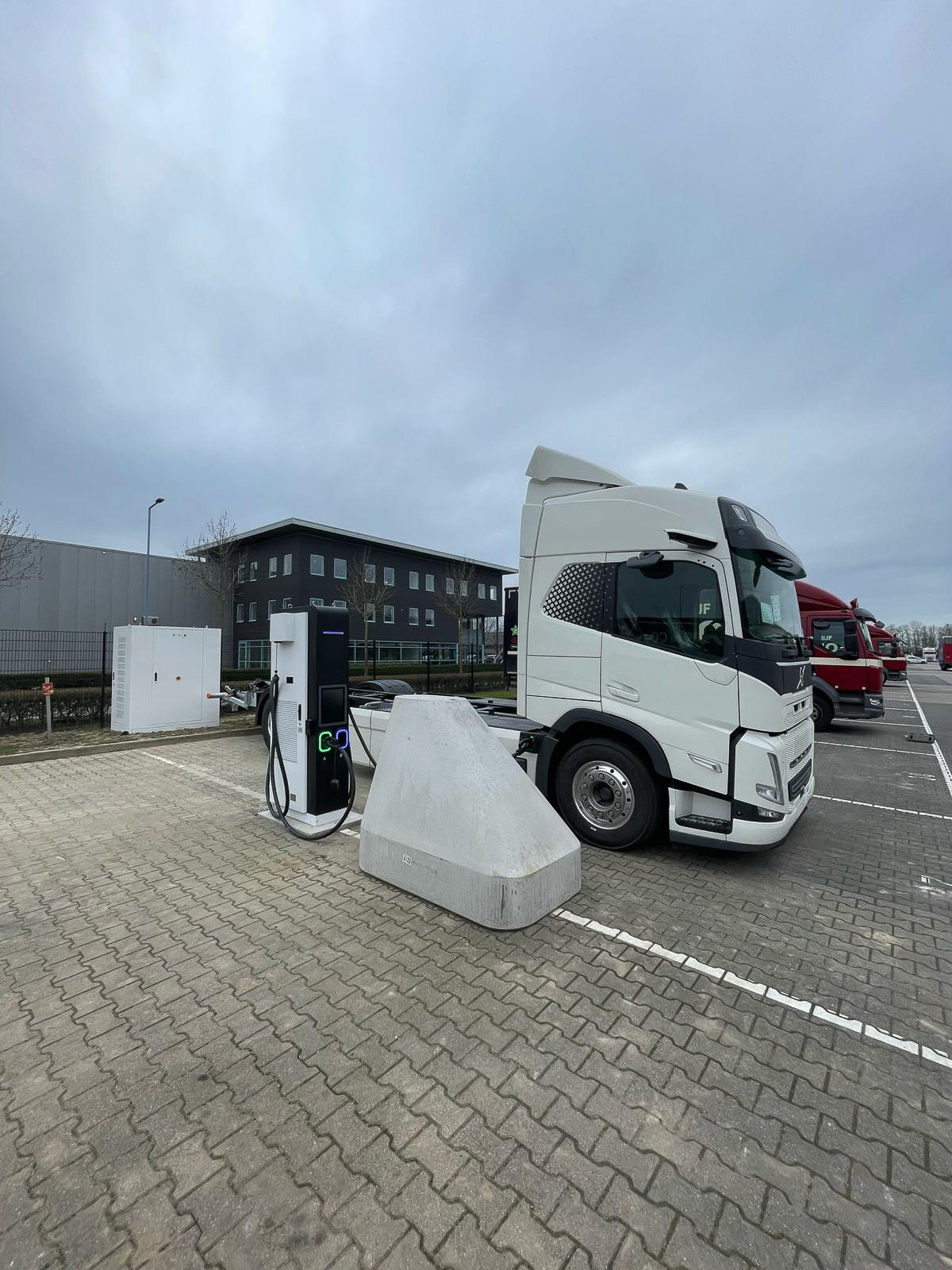
2. The Electric Truck: Volvo FH Electric
The Volvo FH Electric is one of the most deployed electric trucks for regional transport.
- Battery Architecture: The Volvo FH Electric uses a 400V system.
- Max. Payload: This vehicle can fast charge with a capacity of up to 250 kW.
- Charging time: When using a 250 kW DC charger, the battery can be charged to 80% in less than 90 minutes. A full charge from 0 to 100% takes about 2 hours.
- Innovation: The newer generations, such as the FH Aero Electric, are already prepared for the new Megawatt Charging (MCS) standard, which reduces charging time from 20% to 80% to just 40 minutes during the driver's mandatory rest break.
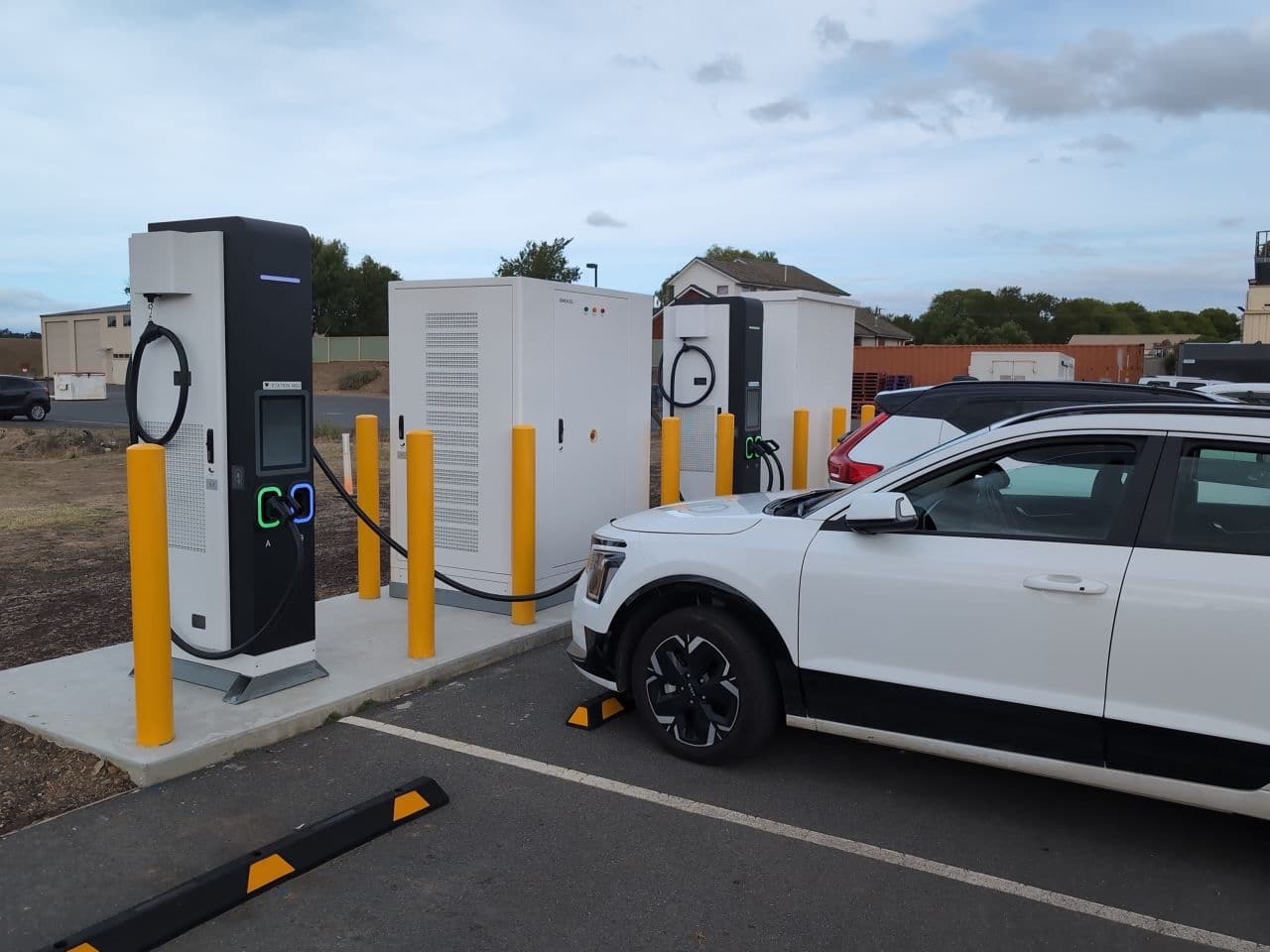
3. The electric car: Tesla Model 3 (Long Range)
The Tesla Model 3 is an example of how an efficient BMS and battery voltage work together to minimise the charging time of an electric car.
- Battery Architecture: The Tesla Model 3 uses a 400V system. Tesla achieves extremely high speeds by temporarily boosting the amperage (I) very high.
- Max. Payload: With a suitable fast charger (such as the Voltra 500A), the Model 3 can charge at a peak capacity of 250 kW.
- Charging rate: Under ideal conditions, the Model 3 charges from 10% to 80% in about 25 to 30 minutes. In the first 15 minutes, the car can top up to 275 km of range.
Ready for the next step in electrification?
Are you looking for the optimal charging infrastructure for your passenger cars or electric trucks? At Voltra, we are happy to help you translate the jumble of factors into a concrete and future-proof charging plan. We look beyond the charging station; we analyse your grid capacity and vehicle fleet for advice that really works.